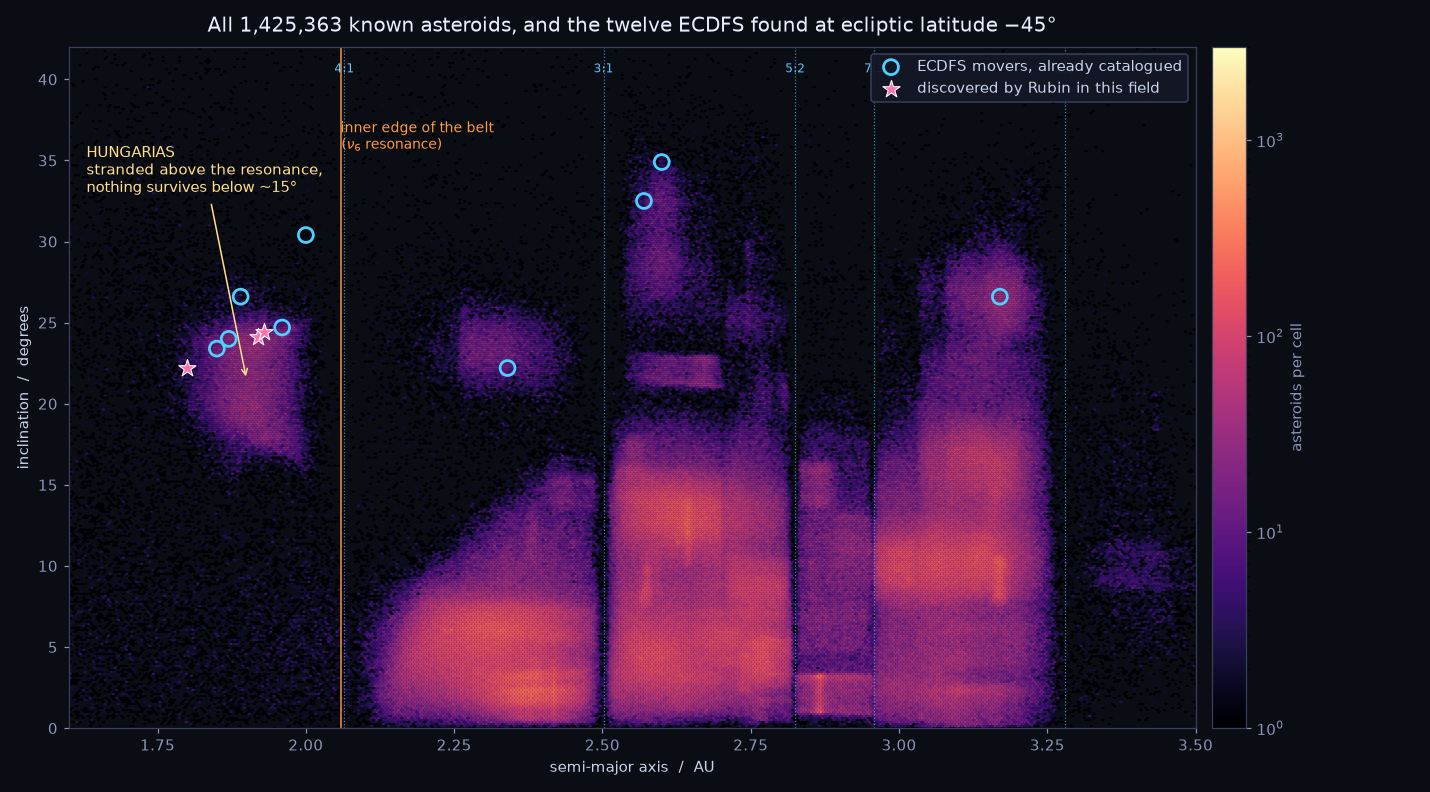
The twelve moving objects found in the ECDFS field, at ecliptic latitude −45.5°. Three of them were new, and Rubin submitted them to the Minor Planet Center. This is Data Preview 1, not the DP2 fortnight.
ECDFS sits at ecliptic latitude −45.5°, nowhere near the plane the asteroids orbit in, so the twelve it caught are not a fair sample of anything. They are the objects whose orbits carry them furthest out of the ecliptic, seen at the moment they get there. Every one is within a degree or two of the highest ecliptic latitude its inclination can reach.
Two effects put a belt asteroid at −45°. The obvious one is a steeply inclined orbit: these have a median inclination of 24.5° against about 8° for the belt at large, putting all of them in the top 4%. The subtler one is geometric. An asteroid’s height above the ecliptic is r sin β, but you observe it from Earth at a distance Δ smaller than r, so the angle is magnified by r/Δ — about 1.7 here. Twenty-four degrees of inclination becomes forty-five degrees on the sky.
Half of them are Hungarias, which are not main belt at all. That island is carved by dynamics rather than by definition: selecting purely on semi-major axis between 1.78 and 2.00 AU, with no inclination cut applied, leaves 30,666 objects of which only 0.5% lie below 15°, against 87% for the main belt. Below that boundary and at low inclination the ν6 resonance pumps eccentricity until the asteroid crosses Mars or falls into the Sun, so only the steeply inclined orbits have survived. Pointing a telescope at −45° ecliptic latitude turns it into a Hungaria detector, because they are both the most numerous population that far off the plane and the nearest, therefore the brightest.
| Object | a / AU | e | incl | nights | arc / d | class | orbit from ECDFS alone |
|---|---|---|---|---|---|---|---|
| 2024 WH103 | 1.80 | 0.110 | 22.2° | 5 | 6.01 | Mars-crosser | usable — new discovery |
| 2018 EB2 | 1.85 | 0.033 | 23.4° | 2 | 1.22 | Hungaria | singular |
| 2016 NR42 | 1.87 | 0.076 | 24.0° | 1 | 0.00 | Hungaria | singular |
| 2003 QT30 | 1.89 | 0.095 | 26.6° | 5 | 4.04 | Hungaria | usable |
| 2024 WE103 | 1.92 | 0.070 | 24.1° | 4 | 3.01 | Hungaria | usable — new discovery |
| 2024 WJ103 | 1.93 | 0.059 | 24.4° | 3 | 2.17 | Hungaria | usable — new discovery |
| 2018 NM29 | 1.96 | 0.071 | 24.7° | 1 | — | Hungaria | no solution |
| 2009 DE | 2.00 | 0.331 | 30.4° | 2 | 0.97 | Mars-crosser | singular |
| 2013 PJ145 | 2.34 | 0.279 | 22.2° | 1 | — | inner belt | no solution |
| 2019 NR5 | 2.57 | 0.302 | 32.5° | 3 | 2.16 | middle belt | recoverable |
| 2015 MV118 | 2.60 | 0.197 | 34.9° | 4 | 3.05 | middle belt | usable |
| 2007 VY289 | 3.17 | 0.370 | 26.6° | 5 | 5.13 | outer belt | usable |
Three observations determine an orbit in principle — six elements, two angles per observation — but being determined and being solvable are different things. Optical astrometry gives angles and no range, and the range enters only through the curvature of the path across the sky. Over an hour, the Earth’s orbital acceleration bends the sight line by roughly 0.06 arcsec, against a measured Rubin astrometric scatter of 0.04. There is essentially no signal, so a single night’s tracklet fixes position and rate but leaves distance unknown.
Propagating a real orbit and differentiating it to get the covariance, three observations of 2001 SQ248 spread over a widening arc give:
| Arc | σ(a)/a | Ephemeris error a year later |
|---|---|---|
| 1 hour (one tracklet) | 585% | unconstrained |
| 6 hours (one night) | 56% | 28° |
| 2 days | 1.6% | 6.2° |
| 7 days | 0.16% | 33′ |
| 15 days | 0.032% | 7.4′ |
| 30 days | 0.008% | 2.2′ |
Roughly an inverse-square law, so doubling the arc buys a factor of four. And arc length cannot be traded for sheer number of fixes: going from 3 to 30 observations in one night helps, but 30 to 300 only buys the square root you would get from averaging noise, landing at 0.7%. Three observations spread over 15 days reach 0.032%, twenty times better than three hundred crammed into a single night. You cannot average your way to curvature that is not there.
For ECDFS that works out to seven of the twelve yielding a usable orbit from this field alone, and the boundary falls exactly at three nights — the same criterion Rubin’s own linking uses. Three of the seven were genuinely new, submitted to the Minor Planet Center on 2025-06-27. What limits the arc is not the 28-night campaign but the field itself: 1.4° across, crossed in five to seven days at main-belt rates, which is why the longest arc on any object is 6.01 days.
Caveats. This starts from the published DiaSource
detection catalogue, not from raw pixels; producing those detections yourself
means running difference imaging against templates, which is the expensive
part. The tracks are single-night tracklets, so turning one into a designated
object still requires orbit determination and linking across nights. And the
ECDFS completeness figures rest on ten objects across three nights, so treat
them as indicative.
The orbit figures are linearised covariances evaluated around the known solution, so they describe how well a set of epochs constrains an orbit you have already found; Gauss initial-orbit determination from scratch on a two-day arc is harder and can admit several roots. Propagation is two-body with no planetary perturbations, which makes the one-year column optimistic. Both push the same way, so seven of twelve is an upper bound — though the three MPC submissions are independent proof that at least those arcs sufficed.
The single-night tracks and the coadd test stay on the moving-objects page. The DP2 fortnight is a separate measurement.