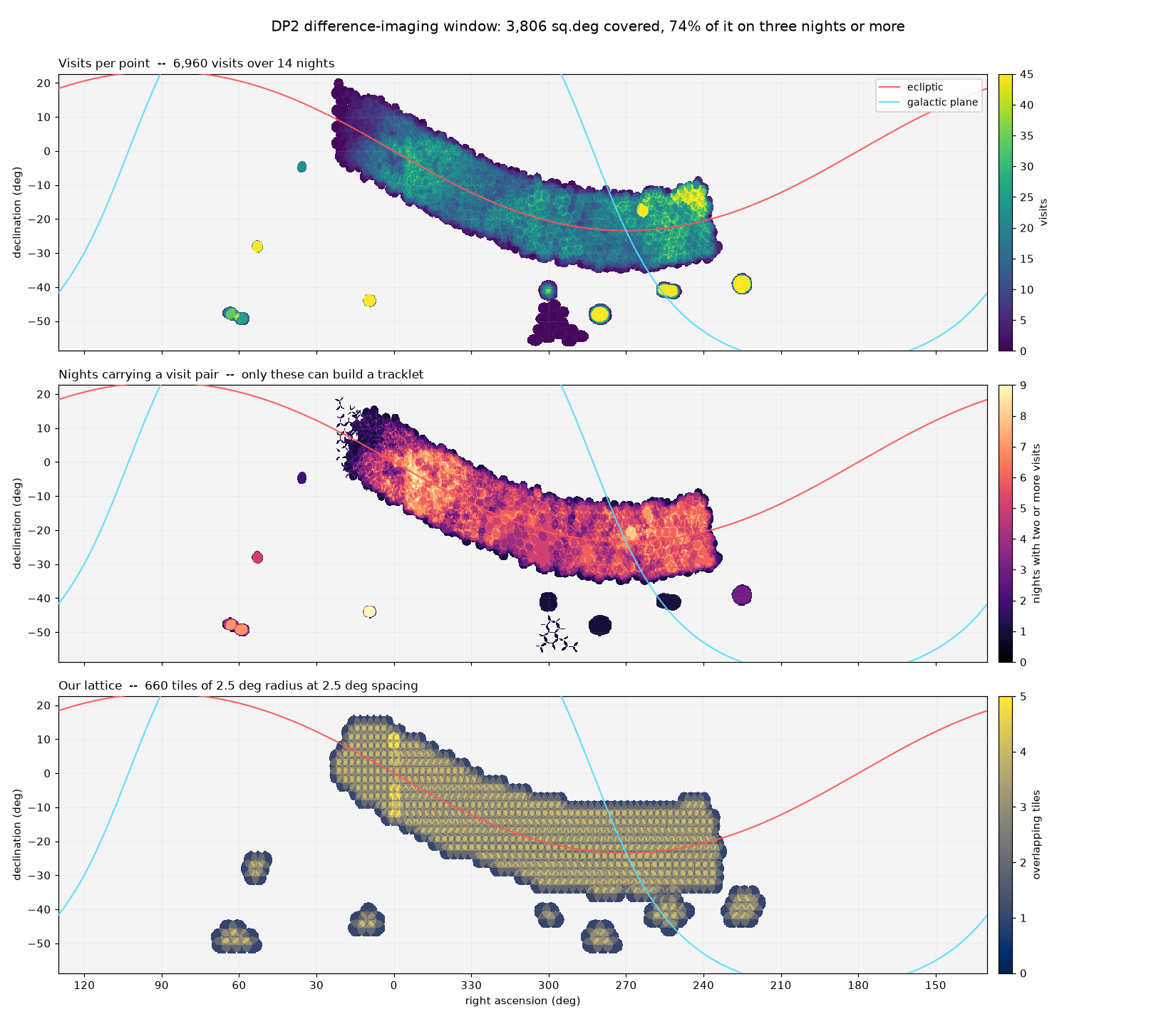
Blind linking of the real detections over the whole DP2 window, fourteen nights from MJD 60865 to 60878. 625 of 660 search tiles are in this merge. The orbits are drawn here.
The window holds 6,960 visits. After the signal-to-noise cut, the reliability cut at 0.5 and the pixel-flag cuts, 8.5 million detections remain, and 245,598 catalogued objects appear in them. A discoverable object, the denominator used here, has a pair of detections 5 to 90 minutes apart on each of three or more nights. That is 97,145 objects, 39.6% of those present. The rest of the loss is measured on the detections page. It is cadence and missing detections, not the linker.
The sky is covered by 660 cones of radius 2.5° whose centres
are 2.5° apart, because an object can drift about 3° in a fortnight
and a tile that loses it would also drop it from its own denominator. Each
tile is linked with heliohypo_rubin324, heliocentric distances
from 1.5 to 9.8 AU, then purified. The clustering radius is 150,000 km and
the tracklet cap is 0.6° per day. 35 tiles are
not in the merge. They can only add recoveries, so the completeness above is
a floor.
The search recovered 94,804 of the 97,145 discoverable objects. It also returned a pure linkage for 11,033 further catalogued objects. Those fall outside the discoverable definition because the tracklet window is wider than the 5-to-90-minute pair the denominator requires, so they are not in the completeness ratio. Together that is 105,837 catalogued objects.
Linkages that are not a single catalogued object are matched across the overlapping tiles when they share a majority of their detections. 6,198 remain that mix more than one catalogued object, and 15,940 that contain none. Of the 127,975 linkages left after that matching, 82.7% are one object, 4.8% are mixed and 12.5% are unlabelled.
Each surviving linkage is fitted with a two-body orbit. 102,517 fits are bound and 3,320 are not. An unbound fit on a fortnight's arc is not a real object, so that 3.1% is a contamination estimate that does not need the truth table. The bound orbits have a median arc of 8.0 days and a median residual of 0.050″. 99,729 of them, 97.3%, are under 0.2″. The orbits page hides the other 2,788 unless they are asked for, and it does not draw the unbound fits at all. 95.6% of every fit, bound or not, lands between 1.8 and 4.0 AU. Nothing in the pipeline knows that is where the belt is.
| Nights | Bound orbits | Share |
|---|---|---|
| 3 | 72,597 | 70.8% |
| 4 | 22,081 | 21.5% |
| 5 | 5,963 | 5.8% |
| 6+ | 1,876 | 1.8% |
The counts are the well-fitted orbits, the same boxes the orbit diagram highlights. The inner, middle and outer belts are broad zones. The named groups sit inside or beside them, so the rows are not a partition and should not be added. The near-Earth and Mars-crosser rows also require an arc of at least five days and a residual under 0.05″, because a small perihelion on a fortnight's arc is an extrapolation. The diagram's notes go through why.
| Group | Box | Orbits | What it is |
|---|---|---|---|
| Hungaria | a 1.78–2.0, e < 0.18, i 16–34° | 609 | 1.78-2.00 AU, high inclination, interior to the belt |
| Phocaea | a 2.25–2.5, e 0.1–1.0, i 18–32° | 178 | inner belt, high inclination |
| inner belt | a 2.06–2.5 | 31,283 | inside the 3:1 |
| middle belt | a 2.5–2.82 | 34,384 | between the 3:1 and the 5:2 |
| outer belt | a 2.82–3.28 | 30,761 | between the 5:2 and the 2:1 |
| Alinda | a 2.45–2.56, e 0.4–1.0 | 30 | in the 3:1 gap on eccentric, Earth-approaching orbits |
| Griqua | a 3.15–3.35, e 0.35–1.0 | 118 | in the 2:1 gap on eccentric orbits |
| Cybele | a 3.27–3.7, e < 0.3 | 990 | beyond the 2:1 |
| Hilda | a 3.7–4.2, e < 0.3 | 598 | the 3:2 resonance with Jupiter |
| Mars-crosser | a < 4.2, q 1.3–1.666, arc ≥ 5 d, residual < 0.05″ | 217 | perihelion between 1.3 and 1.666 AU |
| near-Earth | a < 4.2, q < 1.3, arc ≥ 5 d, residual < 0.05″ | 18 | perihelion inside 1.3 AU |
Source: output/linking/footprint on the cluster,
merge of 625 tiles, and scratch/orbits.csv, the catalog
drawn on the orbits page.