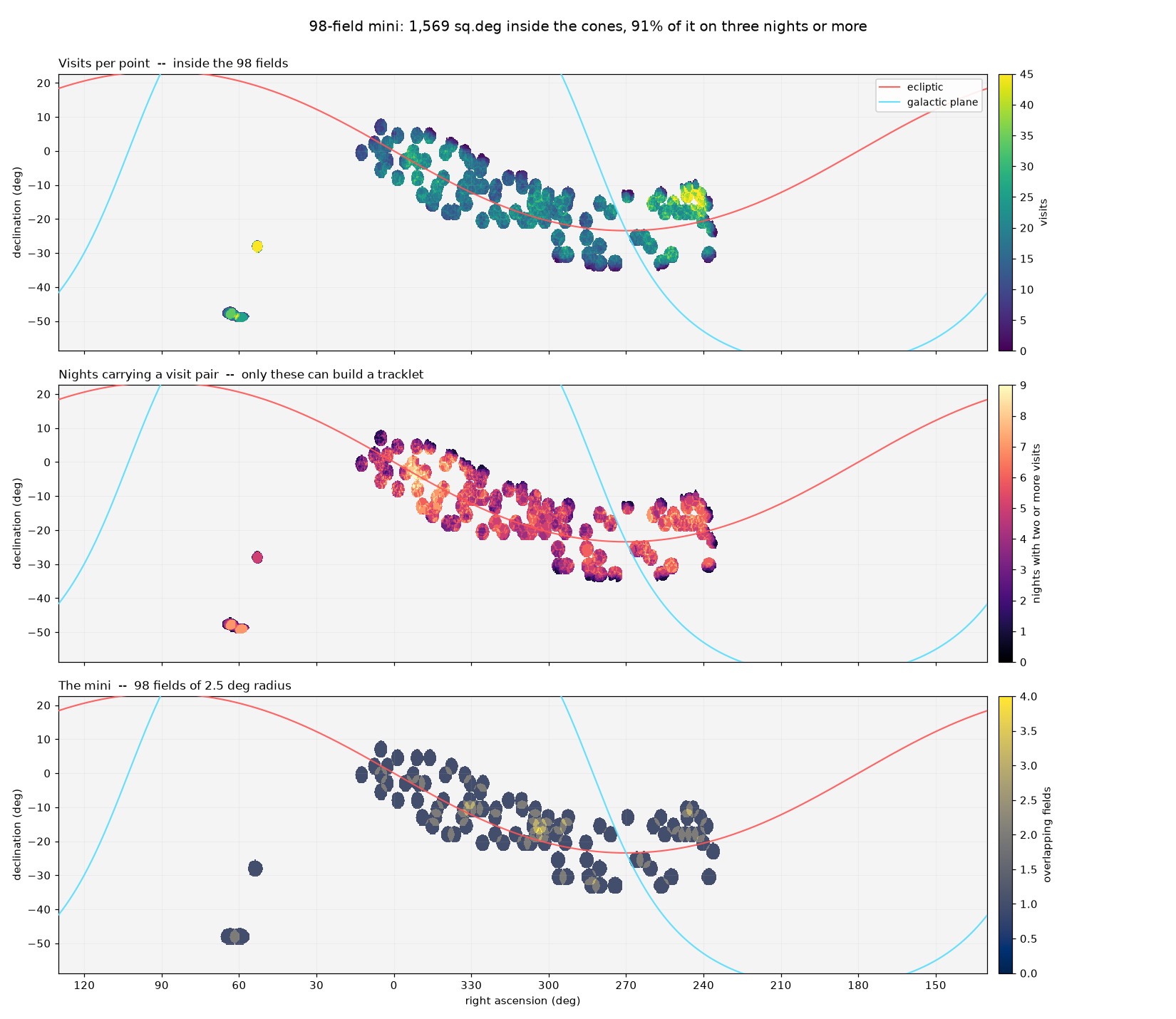
Job 55538569 planted 57,000 distant orbits on the mini ladder and linked them with a grid that starts at 5 AU. 27,650 were recovered.
Perihelion is drawn uniformly from 30 to 42 AU, eccentricity from 0.01 to
0.15, and inclination from 0 to 30° with the isotropic weight
sin i. Node, argument of perihelion and mean anomaly are uniform,
and a body is kept only when it lies in the field at the field's midpoint.
Apparent magnitude is uniform from 19 to 25.5, solved for at that instant, so
a body at 50 AU is the same brightness as one at 30 AU. The hypothesis grid
is hihyp02b_tno, 403 rows from 5.0 to 49.8 AU. The tracklet cap
is the production cap, 90 arcsec per hour. There is no second pass.
In this draw semi-major axis runs from 30.3 to 49.3 AU (median 39.1), eccentricity from 0.010 to 0.150 (median 0.080), and inclination from 0.09° to 30.0° (median 16.0°). Heliocentric distance at the visits runs from 30.0 to 56.4 AU (median 39.2). 95 fields received 600 orbits. Fields 8 (ecliptic latitude -66°), 9 (ecliptic latitude -67°) and 119 (ecliptic latitude -46°) received none: the inclination draw stops at 30°, so a body on one of these orbits cannot appear that far off the ecliptic.
| Outcome | Orbits | Share |
|---|---|---|
| never observable | 97 | 0.2% |
| below depth | 10,429 | 18.3% |
| lost to trailing | 0 | 0.0% |
| depth unknown | 12 | 0.0% |
| no tracklet | 13,853 | 24.3% |
| no linkage | 3,737 | 6.6% |
| recovered | 27,650 | 48.5% |
| lost to reliability cut | 1,222 | 2.1% |
The median object has 3 paired nights. The median recovered orbit has 5. Every recovery was eligible. Of the 30,396 eligible orbits, 27,650 were recovered. The other 2,746 were not linked: 2,695 were never clustered, 32 were dropped by purify, and 19 were lost in a crowded cluster.
The median on-sky rate is 2.6 arcsec per hour, and the 90th percentile is 3.5. None of the orbits move faster than the production cap, and none are lost to trailing.
Eligible recall is 0.96 from V 19 to 21 and 0.82 from V 22 to 23. Fainter than V 23, 1,001 of 22,034 are recovered, and only 1,494 of those were eligible, a recall of 0.670. Magnitude is what changes the recovered fraction. Once an orbit is eligible, the grid still links most of the brighter ones.
| V | Orbits | Recovered | Share | Eligible | Eligible recall |
|---|---|---|---|---|---|
| <19 | 10 | 9 | 90.0% | 10 | 0.900 |
| 19–21 | 17,399 | 15,146 | 87.1% | 15,834 | 0.957 |
| 21–22 | 8,765 | 6,954 | 79.3% | 7,513 | 0.926 |
| 22–23 | 8,695 | 4,540 | 52.2% | 5,545 | 0.819 |
| 23–24 | 8,793 | 997 | 11.3% | 1,480 | 0.674 |
| ≥24 | 13,241 | 4 | 0.0% | 14 | 0.286 |
Apparent magnitude stays near 22.2 in every distance bin, because it was assigned rather than taken from a size. Eligible recall stays near 0.91 from 30 to 50 AU and falls to 0.76 past 50 AU. Perihelion, eccentricity and inclination do not move it. Across those draws it stays near 0.91.
| Distance, AU | Orbits | Recovered | Share | Eligible | Eligible recall |
|---|---|---|---|---|---|
| 30–35 | 11,892 | 5,889 | 49.5% | 6,395 | 0.921 |
| 35–40 | 20,050 | 9,692 | 48.3% | 10,594 | 0.915 |
| 40–45 | 17,207 | 8,521 | 49.5% | 9,333 | 0.913 |
| 45–50 | 6,129 | 2,882 | 47.0% | 3,201 | 0.900 |
| 50–60 | 1,625 | 666 | 41.0% | 873 | 0.763 |
One row from the first batch of each of the 95 fields. This grid starts at 5 AU, so it is not the production main-belt grid. On this ladder that grid recovered 0.827 of eligible real objects, with 0.31% mixed. Here 70,351 real objects were eligible, about as many as on the main-belt grid, and this grid found 36,549 of them. 33,284 of the misses were never clustered. Of 52,978 linkages, 47,283 are pure (89.3%), 288 are mixed (0.54%), and 5,407 are unlabelled (10.2%).
Source: the field tables in
output/linking/swarm_map_tno-mini, job 55538569.