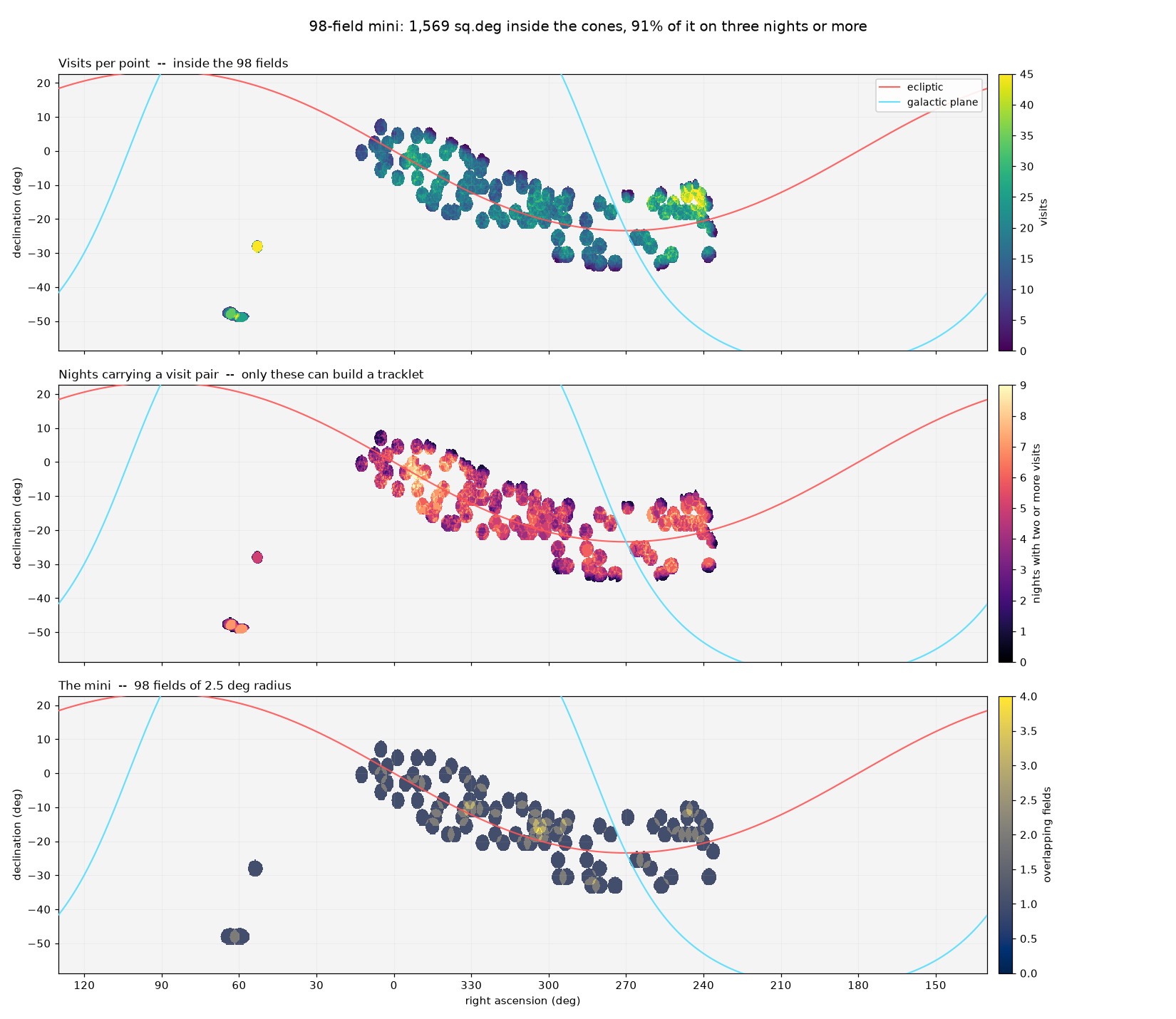
Two injections on the same 98 fields. Job 55507022 assigns
apparent magnitude. Job 55515733 assigns a diameter. Both are linked with
heliohypo_rubin324 and then heliohypo_neo324.
The brightness orbits are drawn here.
Each batch asks for an equal share of Atira, Aten, Apollo and Amor. A class that does not land in the field is left short, rather than backfilled. No Atira landed. Aten landed less often than Apollo or Amor, because fewer of those orbits sit in the field. Perihelion is at least 0.2 AU, eccentricity runs from 0 to 0.9, and node, argument of perihelion and mean anomaly are uniform. Inclination follows the Granvik et al. (2018) distribution of the class. The orbits that landed are the ones the field could hold, so their median inclinations are lower than that distribution: 17° for Aten, 11° for Apollo and 9° for Amor. The ladder is the 98-field quarter. Both runs came out at 58,690 orbits, a few short of 600 in each field.
The brightness run, job 55507022, draws apparent magnitude uniformly from
19 to 25.5 at the epoch. The diameter run, job 55515733, uses the same
fields, seeds and grids, and draws a log-uniform diameter from 50 m to 3 km
in place of that magnitude. Absolute magnitude follows
D = 1329 pV−1/2 10−0.2 H
at albedo 0.14, about 24.3 at 50 m and 15.4 at 3 km. Apparent magnitude is
then the magnitude that diameter has at the epoch. Later batches are not the
same orbits, because a fainter population changes how many objects the next
batch asks for. The second grid is heliohypo_neo324 with a
minimum geocentric distance of 0.01 AU. The tracklet cap is the production
cap, 90 arcsec per hour.
| Outcome | Brightness | Diameter | ||
|---|---|---|---|---|
| Orbits | Share | Orbits | Share | |
| never observable | 328 | 0.6% | 316 | 0.5% |
| below depth | 11,768 | 20.1% | 28,368 | 48.3% |
| lost to trailing | 127 | 0.2% | 25 | 0.0% |
| depth unknown | 8 | 0.0% | 9 | 0.0% |
| no tracklet | 18,732 | 31.9% | 15,313 | 26.1% |
| no linkage | 4,983 | 8.5% | 4,163 | 7.1% |
| recovered | 21,558 | 36.7% | 9,771 | 16.6% |
| lost to reliability cut | 1,186 | 2.0% | 725 | 1.2% |
On the brightness run the median object has 2 paired nights, and a recovered orbit has 4. On the diameter run those medians are 0 and 4. The second pass recovered 201 brightness orbits and 245 diameter orbits that the first grid missed. Of the eligible orbits that were not recovered, 2,462 of 2,504 on the brightness run and 1,782 of 1,802 on the diameter run were never clustered.
The median on-sky rate is 34 arcsec per hour on the brightness run and 33 on the diameter run. 9,291 brightness orbits (15.8%) and 8,350 diameter orbits (14.2%) move faster than the production cap. 127 brightness orbits and 25 diameter orbits are lost to trailing. The diameter run loses fewer that way because the small bodies fall below the depth first.
Eligible recall is about 0.91 for Apollo and Amor when brightness is assigned, and 0.59 for Aten. The diameter run is lower for Apollo and Amor, 0.87, and the Aten figure is unchanged. Two things hold Aten down. Only 12.3% qualify on the brightness run and 13.7% on the diameter run, against about half of Apollos and Amors when magnitude is assigned. Of the Atens that do qualify, the grid recovers 0.59 rather than 0.91. They are fast and close, so the three-night cut and the grid both bite, and changing the brightness barely moves the eligible recall.
| Class | Brightness | Diameter | ||||
|---|---|---|---|---|---|---|
| Orbits | Recovered | Eligible recall | Orbits | Recovered | Eligible recall | |
| Aten | 9,969 | 7.3% | 0.593 | 8,571 | 8.2% | 0.596 |
| Apollo | 24,477 | 41.8% | 0.916 | 25,159 | 16.1% | 0.874 |
| Amor | 24,244 | 43.7% | 0.909 | 24,960 | 20.1% | 0.871 |
With magnitude assigned, eligible recall is 0.93 from V 19 to 21 and 0.83 from V 22 to 23. Fainter than V 23, 854 of 22,443 are recovered. Median apparent magnitude is 22.3. A few objects fall outside 19 to 25.5 because the magnitude was solved at the epoch and the visits are not that instant.
| V | Orbits | Recovered | Share | Eligible | Eligible recall |
|---|---|---|---|---|---|
| <19 | 98 | 50 | 51.0% | 55 | 0.909 |
| 19–21 | 17,860 | 11,783 | 66.0% | 12,662 | 0.931 |
| 21–22 | 8,826 | 5,306 | 60.1% | 5,831 | 0.910 |
| 22–23 | 9,135 | 3,565 | 39.0% | 4,314 | 0.826 |
| 23–24 | 8,993 | 849 | 9.4% | 1,190 | 0.713 |
| ≥24 | 13,450 | 5 | 0.0% | 9 | 0.556 |
Log-uniform diameter puts about as many orbits in each bin below, so the unweighted recovered fraction, 16.6%, is carried by the kilometre-scale bodies. A cumulative population N(>D) ∝ D−2.5 does the opposite: 96% of the weight is under 200 m. Weighted by that, 0.98% of the population is recovered and 1.49% is eligible. Eligible recall falls to 0.653, because the weight sits where the bodies are faintest. Median apparent magnitude on this run is 24.1, against 22.3 when magnitude was assigned. Fainter than V 23, 568 of 35,849 are recovered.
| Diameter | Orbits | Recovered | Share | Eligible | Eligible recall | Weight |
|---|---|---|---|---|---|---|
| 50–100 m | 10,074 | 49 | 0.5% | 83 | 0.590 | 78.7% |
| 100–200 m | 9,946 | 181 | 1.8% | 296 | 0.608 | 16.8% |
| 200–500 m | 13,107 | 1,030 | 7.9% | 1,394 | 0.739 | 3.7% |
| 0.5–1 km | 9,989 | 1,983 | 19.9% | 2,410 | 0.822 | 0.5% |
| 1–3 km | 15,574 | 6,528 | 41.9% | 7,386 | 0.884 | 0.2% |
One row from the first batch of each field. Both jobs use the production grids, and the control matches. The brightness run found 58,216 of 70,378 eligible real objects (0.827). The diameter run found 58,196 of 70,375 (0.827). Of the first-pass linkages, the brightness run has 72,417, of which 64,615 are pure (89.2%), 226 are mixed (0.31%), and 7,576 are unlabelled (10.5%). The diameter run has 70,118 linkages, 62,318 pure (88.9%), 220 mixed (0.31%), and 7,580 unlabelled (10.8%). Of the real misses, 11,504 on the brightness run and 11,539 on the diameter run were never clustered.
Source: the field tables in
output/linking/swarm_map_neogroups-v-mini, job 55507022, and
output/linking/swarm_map_neogroups-b-mini, job 55515733.