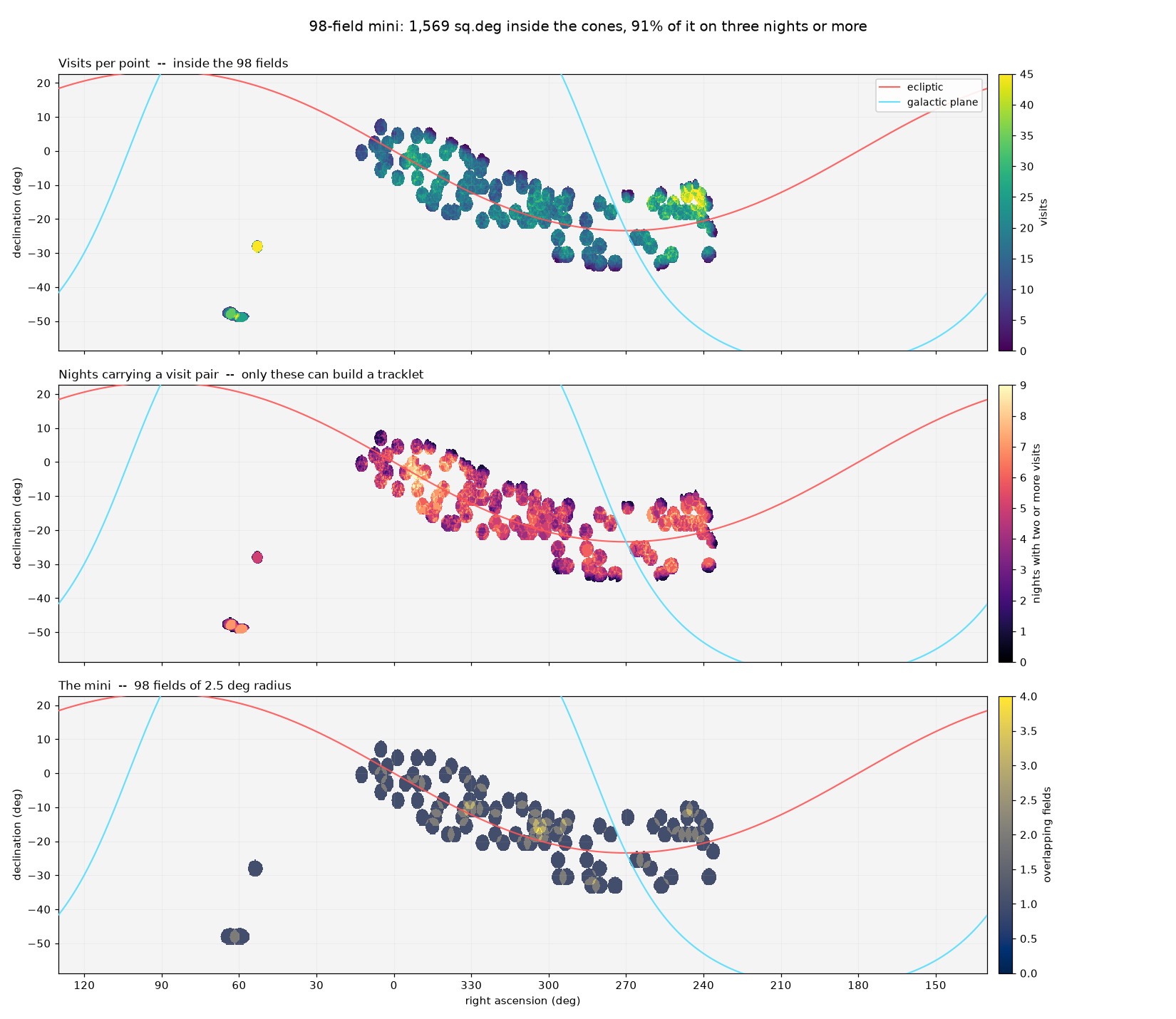
Job 55540213 planted 57,002 orbits drawn from the Granvik et al. (2017) main belt on the mini ladder and linked them with the production grid. 26,815 were recovered. The orbits are drawn here.
The orbits are draws, with replacement, from the current JPL catalog cut
the way Granvik et al. (2017) cut the 2012 MPC catalog: perihelion beyond
1.3 AU, semi-major axis inside 4.1 AU, an observed arc of at least 30 days,
and H below 15.9 inside 2.5 AU or below 14.4 outside it. That selection has
56,813 orbits. Node, argument of perihelion and mean anomaly are redrawn, so
a body lands in a field only when its position at the field's midpoint falls
there. Apparent magnitude is uniform from 19 to 25.5, solved for at that
instant. The hypothesis grid is heliohypo_rubin324 and the
tracklet cap is the production cap, 90 arcsec per hour. There is no second
pass.
In this draw semi-major axis runs from 1.39 to 4.03 AU (median 2.43), eccentricity from 0.001 to 0.56 (median 0.134), and inclination from 0.02° to 46.7° (median 6.0°). 95 fields received the full 600 orbits. Fields 8 (ecliptic latitude -66°, 1 orbit) and 119 (ecliptic latitude -46°, 1 orbit) sit far enough off the ecliptic that a belt inclination almost never reaches them, and field 9 (ecliptic latitude -67°) received none.
| Outcome | Orbits | Share |
|---|---|---|
| never observable | 102 | 0.2% |
| below depth | 10,501 | 18.4% |
| lost to trailing | 1 | 0.0% |
| depth unknown | 4 | 0.0% |
| no tracklet | 14,708 | 25.8% |
| no linkage | 3,576 | 6.3% |
| recovered | 26,815 | 47.0% |
| lost to reliability cut | 1,295 | 2.3% |
The median object has 3 paired nights. The median recovered orbit has 4. Of the 29,301 eligible orbits, 26,808 were recovered. The other 2,493 were not linked, and 2,414 of those were never clustered. 7 recoveries were not eligible.
The median on-sky rate is 24 arcsec per hour, and the 90th percentile is 38. 2 orbits move faster than the production cap. One orbit is lost to trailing. The median trailing loss is 0.007.
Each orbit takes one label. Hungaria is 1.78–2.00 AU with eccentricity at most 0.18 and inclination 16–34°. Phocaea is 2.25–2.50 AU with eccentricity at least 0.1 and inclination 18–32°. The inner belt is inside the 3:1, the middle belt between the 3:1 and the 5:2, and the outer belt between the 5:2 and the 2:1. Cybele is 3.27–3.70 AU and Hilda is the 3:2, both with eccentricity at most 0.3. A named group wins where it overlaps a belt zone. 31 orbits fall just outside a box, mostly Hildas with eccentricity a little over 0.3 or bodies interior to 2.06 AU that miss the Hungaria box, and those are shown with the neighbouring class. Eligible recall is about 0.9 in every class. Hungaria and Phocaea are recovered a little less often because fewer of them ever get three nights.
| Class | Orbits | Recovered | Share | Eligible | Eligible recall |
|---|---|---|---|---|---|
| Hungaria | 144 | 60 | 41.7% | 64 | 0.938 |
| Phocaea | 453 | 180 | 39.7% | 202 | 0.891 |
| inner belt | 32,022 | 14,818 | 46.3% | 16,332 | 0.907 |
| middle belt | 7,788 | 3,700 | 47.5% | 4,020 | 0.920 |
| outer belt | 15,221 | 7,388 | 48.5% | 7,952 | 0.929 |
| Cybele | 424 | 198 | 46.7% | 222 | 0.892 |
| Hilda | 950 | 471 | 49.6% | 509 | 0.925 |
Eligible recall stays above 0.9 for orbits brighter than V 22 and is still 0.84 from V 22 to 23. Fainter than V 23, 1,127 of 22,004 are recovered. Magnitude, not which part of the belt an orbit came from, is what changes the recovered fraction.
| V | Orbits | Recovered | Share | Eligible | Eligible recall |
|---|---|---|---|---|---|
| <19 | 87 | 77 | 88.5% | 81 | 0.951 |
| 19–21 | 17,282 | 14,518 | 84.0% | 15,272 | 0.950 |
| 21–22 | 8,711 | 6,738 | 77.4% | 7,281 | 0.925 |
| 22–23 | 8,816 | 4,355 | 49.4% | 5,192 | 0.838 |
| 23–24 | 8,900 | 1,118 | 12.6% | 1,456 | 0.766 |
| ≥24 | 13,104 | 9 | 0.1% | 19 | 0.474 |
Apparent magnitude was assigned, so it stays near 22.2 in every distance bin. Eligible recall is flat from 1.5 AU out past 3.5 AU. Inclination trims the recovered fraction only past 20°, where Hungaria and Phocaea live, and the eligible recall there is still about 0.9.
| Distance, AU | Orbits | Recovered | Share | Eligible | Eligible recall |
|---|---|---|---|---|---|
| 1.5–2 | 2,483 | 1,079 | 43.5% | 1,272 | 0.847 |
| 2–2.5 | 20,235 | 9,303 | 46.0% | 10,270 | 0.906 |
| 2.5–3 | 21,619 | 10,342 | 47.8% | 11,197 | 0.923 |
| 3–3.5 | 9,699 | 4,649 | 47.9% | 5,009 | 0.928 |
| 3.5–5 | 2,846 | 1,432 | 50.3% | 1,541 | 0.929 |
| Inclination | Orbits | Recovered | Share | Eligible | Eligible recall |
|---|---|---|---|---|---|
| 0–5° | 20,830 | 10,151 | 48.7% | 11,116 | 0.913 |
| 5–10° | 25,749 | 11,850 | 46.0% | 12,976 | 0.913 |
| 10–15° | 7,476 | 3,494 | 46.7% | 3,778 | 0.925 |
| 15–20° | 1,750 | 802 | 45.8% | 859 | 0.934 |
| ≥20° | 1,197 | 518 | 43.3% | 572 | 0.906 |
One row from the first batch of each of the 97 fields that received an orbit. This is the production grid, so the control should match the brightness mini on this ladder, which recovered 0.827 of eligible real objects with 0.31% mixed. Here 70,389 real objects were eligible and the grid found 58,140 of them. 11,518 of the misses were never clustered. Of 77,238 linkages, 69,417 are pure (89.9%), 256 are mixed (0.33%), and 7,565 are unlabelled (9.8%).
Source: the field tables in
output/linking/swarm_map_mba-mini, job 55540213. Angles on the
orbits page were redrawn from the injection seed
and checked against the stored elements.