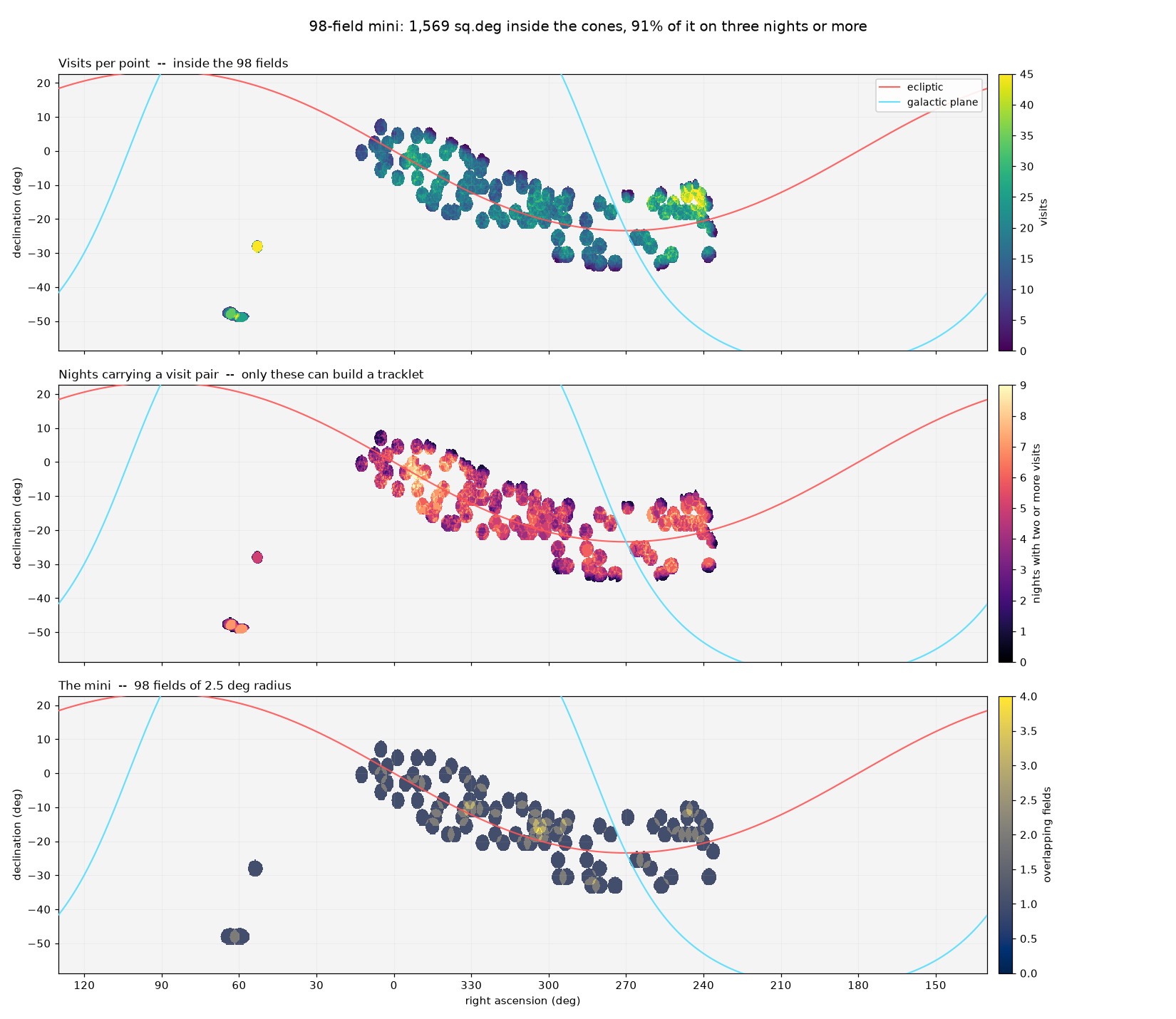
Job 55539682 planted 58,800 hyperbolic orbits on all 98 fields of the mini ladder and linked them with a grid whose radial velocities exceed escape. 1,558 were recovered. The orbits are drawn here.
Each object is placed on the line of sight through its field, at the
field's midpoint, with an excess velocity drawn from 20 to 70 km/s. The
direction of that velocity is isotropic. Perihelion is kept between 0.15 and
5 AU, and in this draw it runs from 0.15 to 3.51 AU.
Every orbit is hyperbolic: eccentricity 1.07 to 19.7,
semi-major axis -2.22 to -0.18 AU. Apparent
magnitude is uniform from 19 to 25.5, solved for at that instant, so a body
at 3 AU is the same brightness as one at 1 AU. The hypothesis grid is
heliohypo_iso, 270 rows from 0.5 to 4 AU with radial velocity out
to 2.2 times escape. The tracklet cap on this job is 1,200 arcsec per hour.
There is no second pass.
| Outcome | Orbits | Share |
|---|---|---|
| never observable | 1,907 | 3.2% |
| below depth | 15,124 | 25.7% |
| lost to trailing | 2,131 | 3.6% |
| depth unknown | 24 | 0.0% |
| no tracklet | 32,039 | 54.5% |
| no linkage | 5,554 | 9.4% |
| recovered | 1,558 | 2.6% |
| lost to reliability cut | 463 | 0.8% |
The median object has one paired night. The median recovered orbit has four. Once an orbit has clean tracklets on three nights inside 15 days, the remaining miss is the grid: every one of the 4,984 eligible orbits that was not recovered was never clustered.
The median on-sky rate is 213 arcsec per hour, and the 90th percentile is 562. 48,870 orbits, 83.1%, move faster than the production cap of 90 arcsec per hour. 9 exceeded this job's cap of 1,200, and none of those was recovered. The median trailing loss is 0.35, and 2,131 orbits are lost to trailing.
Apparent magnitude stays near 22.2 in every distance bin. Eligible recall still rises with heliocentric distance, because the slower passages both stay in the field longer and sit closer to a row of the grid.
| Distance, AU | Orbits | Recovered | Share | Eligible | Eligible recall |
|---|---|---|---|---|---|
| 1–1.5 | 10,854 | 11 | 0.1% | 224 | 0.049 |
| 1.5–2 | 20,390 | 94 | 0.5% | 1,274 | 0.074 |
| 2–3 | 20,587 | 946 | 4.6% | 3,652 | 0.259 |
| 3–5 | 5,062 | 507 | 10.0% | 1,392 | 0.364 |
| Excess velocity, km/s | Orbits | Recovered | Share | Eligible | Eligible recall |
|---|---|---|---|---|---|
| 20–30 | 11,680 | 612 | 5.2% | 1,745 | 0.351 |
| 30–40 | 11,687 | 440 | 3.8% | 1,575 | 0.279 |
| 40–50 | 11,788 | 254 | 2.2% | 1,316 | 0.193 |
| 50–60 | 11,830 | 153 | 1.3% | 1,057 | 0.145 |
| 60–70 | 11,815 | 99 | 0.8% | 849 | 0.117 |
Eligible recall stays near 0.24 from V 19 to V 23. The recovered fraction falls because fewer faint orbits ever get three nights. Fainter than V 23, 42 of 21,747 are recovered.
| V | Orbits | Recovered | Share | Eligible | Eligible recall |
|---|---|---|---|---|---|
| 19–21 | 17,588 | 885 | 5.0% | 3,699 | 0.239 |
| 21–22 | 8,636 | 384 | 4.4% | 1,604 | 0.239 |
| 22–23 | 8,814 | 238 | 2.7% | 985 | 0.242 |
| 23–24 | 8,598 | 42 | 0.5% | 210 | 0.200 |
| ≥24 | 13,149 | 0 | 0.0% | 1 | 0.000 |
An isotropic velocity puts inclination everywhere from 0 to 180 degrees, with median 90°. Prograde orbits spend more nights in the field. Retrograde orbits are linked more often once they qualify.
| Inclination | Orbits | Recovered | Share | Eligible | Eligible recall |
|---|---|---|---|---|---|
| 0–60° | 19,445 | 575 | 3.0% | 3,770 | 0.153 |
| 60–120° | 19,963 | 465 | 2.3% | 1,644 | 0.283 |
| 120–180° | 19,392 | 518 | 2.7% | 1,128 | 0.459 |
One row from the first batch of each of the 98 fields. Real objects still mostly move under 90 arcsec per hour, and 69,248 were eligible, against 70,375 on the main-belt grid over this ladder. This grid found 12,633 of them. 54,416 of the misses were never clustered. Of 63,689 linkages, 50,732 are pure, 31 are mixed (0.049%), and 12,926 are unlabelled (20.3%). On this ladder the main-belt grid recovered 0.827 of eligible real objects, with 0.31% mixed.
Source: the field tables in
output/linking/swarm_map_iso-mini, job 55539682. Angles on the
orbits page were redrawn from the injection seed
and checked against the stored elements.